
Why Proper Air Freight Packing Matters
Proper packing is one of the most critical steps in air freight shipping. Incorrectly packed cargo can result in damage claims, shipment rejection at the airport, additional handling surcharges, or even regulatory penalties for dangerous goods. Airlines and ground handlers have strict requirements — this guide covers everything you need to know to pack your cargo correctly the first time.
Air Freight Packing Requirements by Cargo Type
General Cargo
General cargo includes manufactured goods, machinery parts, consumer electronics, textiles, and similar non-hazardous items. Packing requirements include: strong corrugated cardboard boxes (minimum 275 GSM double-wall for items over 15 kg), internal cushioning with bubble wrap, foam, or air pillows to prevent movement, and sealing with reinforced packing tape on all seams. Each package must be able to withstand stacking of at least 3 layers high — airport warehouses stack pallets, and your cargo must handle the weight.
Fragile Items and Electronics
Electronics, glassware, ceramics, and precision instruments require additional protection. Use anti-static bags for electronic components, double-boxing (inner box surrounded by at least 5 cm of cushioning inside an outer box), corner protectors for items with vulnerable edges, and “FRAGILE” and “THIS SIDE UP” markings on all sides. For high-value electronics, consider custom foam inserts cut to the exact shape of your product.
Perishable Goods
Temperature-sensitive cargo like food, flowers, pharmaceuticals, and biological samples has specific requirements. Use insulated containers (expanded polystyrene or polyurethane) with gel packs or dry ice as needed. All perishable shipments must include a “PERISHABLE” label and the required temperature range (e.g., +2°C to +8°C). Fresh food requires phytosanitary certificates for international shipments. Note: dry ice is classified as a dangerous good (UN 1845, Class 9) and has quantity limits per package — typically 2.5 kg for passenger aircraft belly cargo and 200 kg for freighters.
Dangerous Goods (DG/HAZMAT)
Dangerous goods require UN-certified packaging specific to the substance class and packing group. You must use approved inner receptacles and absorbent material for liquids, proper cushioning to prevent breakage, and the correct DG labels, marks, and documentation. Always consult with your freight forwarder before shipping DG cargo — incorrect DG packaging can result in fines of $5,000–$50,000 and criminal liability. For DG quotes, request a quote and specify the UN number in the additional details field.
Step-by-Step Packing Process
Step 1: Choose the Right Container
Select your packaging based on cargo weight and fragility. For items under 30 kg, use double-wall corrugated boxes. For 30–100 kg, use triple-wall or wooden crates. For 100+ kg, use pallets with stretch wrap and edge protectors. The container must be large enough to allow 3–5 cm of cushioning material on all sides of the product.
Step 2: Protect the Contents
Wrap each item individually in bubble wrap or foam sheeting. Fill all empty spaces with void fill (air pillows, packing peanuts, or crumpled paper) to prevent movement during transit. Items should not shift when you shake the closed box gently. For multi-piece shipments, separate individual items with cardboard dividers.
Step 3: Seal and Reinforce
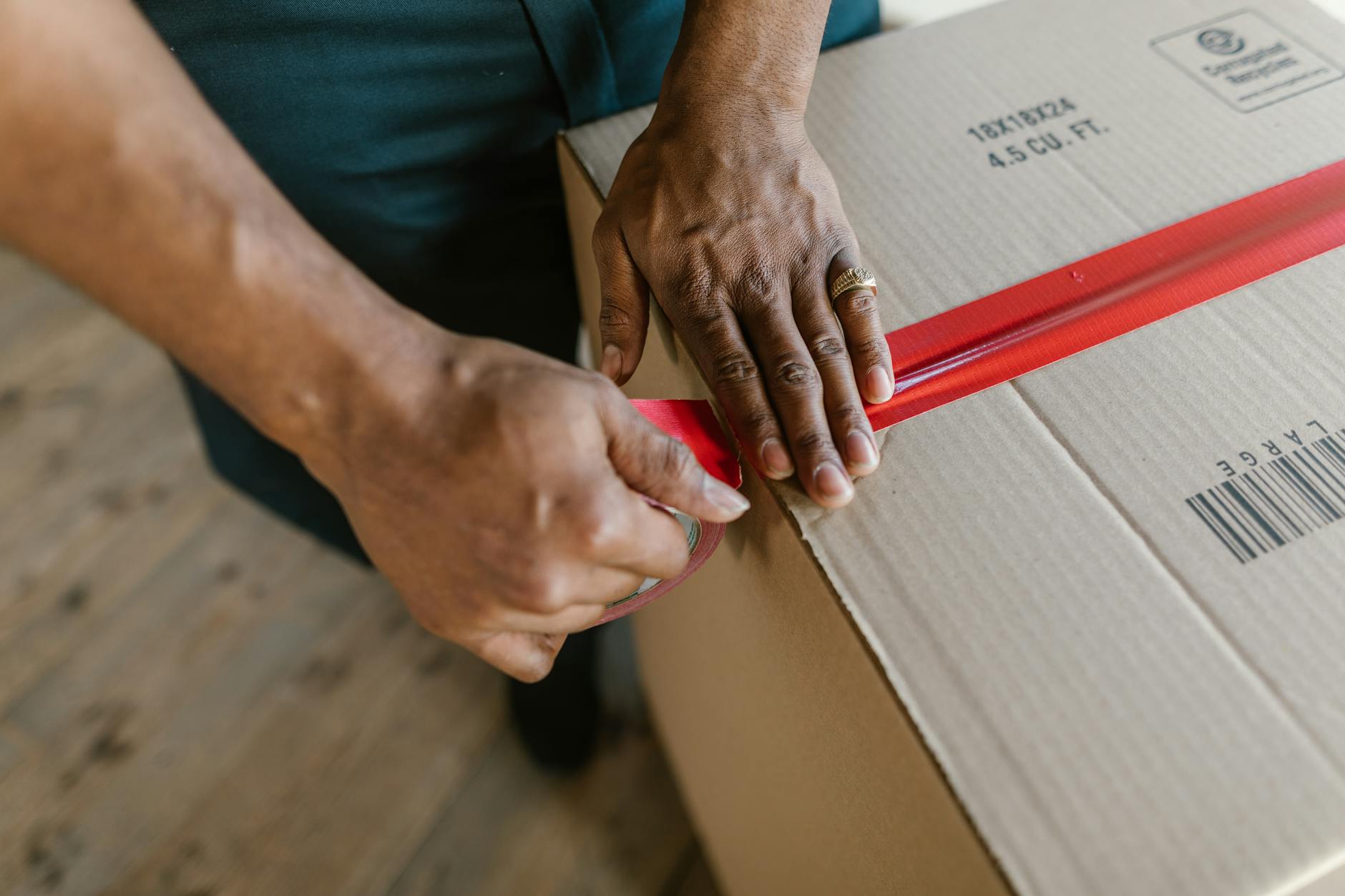
Apply reinforced packing tape (minimum 50 mm wide) using the H-taping method: tape the center seam plus both side seams on top and bottom of the box. For heavy items (over 25 kg), add strapping tape around the box in both directions. Avoid using string, cord, or metal bands that can catch on conveyor systems.
Step 4: Label Correctly
Every package must have: shipper name and address, consignee name and address, total piece count (e.g., “1/3, 2/3, 3/3”), gross weight in kilograms, and any handling labels (FRAGILE, THIS SIDE UP, KEEP DRY, PERISHABLE). Labels should be placed on at least two sides of each package. Use waterproof labels or cover paper labels with clear tape.
Step 5: Measure and Weigh
After packing, measure the final external dimensions (Length × Width × Height in centimeters) and weigh each package on a calibrated scale. These measurements determine your chargeable weight — airlines charge whichever is higher: actual weight or volumetric weight (L × W × H / 6000). Accurate measurements prevent billing disputes and delays.
Common Packing Mistakes That Cost Money
Oversized packaging is the most expensive mistake. Using a box that’s 20% larger than necessary increases your volumetric weight proportionally, wasting money on weight you did not need to ship. Insufficient cushioning leads to damage claims, which take 30–90 days to process and often recover only 60–80% of the declared value. Missing or incorrect labels cause delays at origin handling — airlines will hold unidentifiable shipments until documentation is resolved, adding 24–48 hours to your transit time.
Tools You Need for Air Freight Packing
Essential packing tools for regular shippers include: a calibrated scale (accurate to ±0.1 kg), measuring tape (3 m minimum), reinforced packing tape and dispenser, bubble wrap rolls (10 mm and 25 mm bubble), box cutter, strapping tape for heavy items, waterproof marker for labeling, and a supply of correctly-sized double-wall corrugated boxes. For frequent shippers, investing in a floor-standing platform scale and a tape gun saves significant time.
Frequently Asked Questions
What packing materials are not allowed for air freight?
Straw, hay, and unprocessed wood shavings are prohibited as packing materials for international air freight due to pest and biosecurity regulations. Metal bands and wire ties should be avoided as they can damage conveyor systems. Loose-fill polystyrene (“packing peanuts”) is discouraged for air freight as it can shift during pressure changes — use air pillows or foam-in-place instead.
Do airlines provide packaging for air freight?
Airlines generally do not provide packaging — you are responsible for presenting cargo ready-to-fly at the origin warehouse. However, most freight forwarders offer packing services for an added fee depending on the complexity. Some airports also have packing stations available for shipper use. If you need packing assistance, mention it when requesting your quote.
Can I ship items without a box by air freight?
Some items can ship unboxed if they are structurally rigid (e.g., machinery, engines, vehicles). These must be secured to pallets with straps or chains and wrapped in protective material. However, most airlines require all items to be in closed packaging to prevent damage to other cargo. Unpackaged items may incur an additional handling surcharge.
What happens if my air freight cargo is poorly packed?
Poorly packed cargo may be rejected at the origin warehouse, requiring you to repack before the airline accepts it — this adds 12–24 hours and additional repacking costs. If damage occurs in transit due to inadequate packing, the carrier’s liability is typically limited and your claim may be partially or fully rejected. Most carrier liability is capped at 22 SDR/kg (~€27/kg) under the Montreal Convention, and this cap only applies if the carrier is at fault, not if packaging was inadequate.
Global air freight market benchmark
Global - all lanes: $3.11 /kg
Freightos does not publish a corridor-specific index for this route. The figure below is the global air freight index and is shown as a market reference only, not a quote for this lane.
Updated 25 October 2026. Source: Freightos Air Index (FAX), published by Freightos — terminal.freightos.com. Full index history
Get an Instant Quote — Fill In Below
No need to go anywhere else — request your free air-freight quote right here.